
Module 1 — General Principles of Pharmacology · Course 2 of 5
Role in Module 1: connects dose with drug exposure over time. Recommended after Introduction to Clinical Pharmacology. You can reopen any lesson at any time — your Quick Recall results show which concepts to revisit.
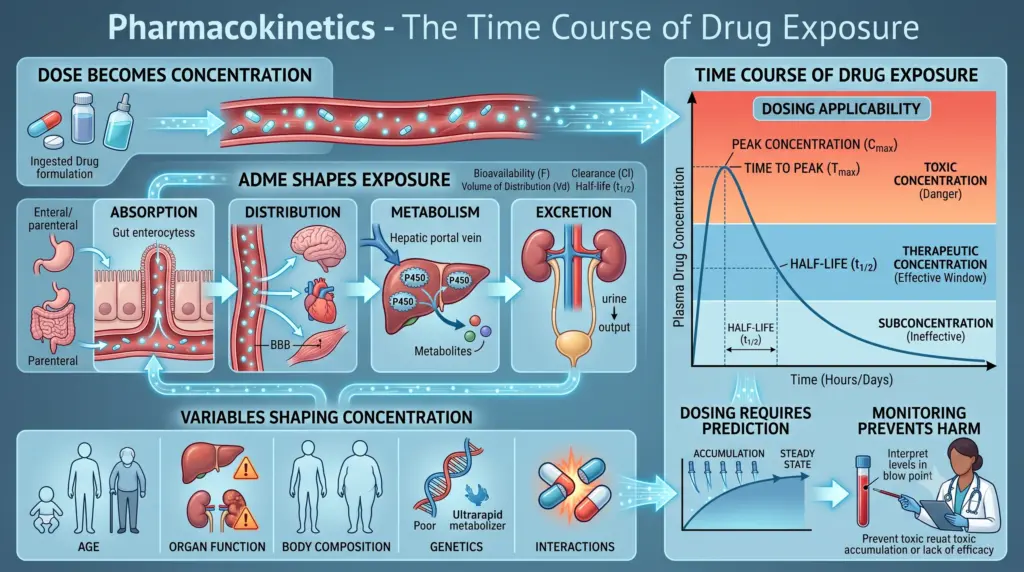
Pharmacokinetics explains how dose becomes concentration through absorption, distribution, metabolism, and excretion, and how those principles guide safe dosing and monitoring.
Course Content
01. Pharmacokinetics: The Time Course of Drug Exposure
You don't currently have access to this content
02. Why Pharmacokinetics Matters Clinically
You don't currently have access to this content
03. Pharmacokinetics vs Pharmacodynamics
You don't currently have access to this content
04. ADME: The Drug Journey
You don't currently have access to this content
Quick Recall Check 1: Foundations of Pharmacokinetics
You don't currently have access to this content
05. The Four Core PK Parameters
You don't currently have access to this content
06. Biological Barriers to Drug Movement
You don't currently have access to this content
07. Passive Diffusion and Surface Area
You don't currently have access to this content
Quick Recall Check 2: Core Parameters and Barriers
You don't currently have access to this content
08. Carrier-Mediated Transport
You don't currently have access to this content
09. High-Yield Transporters in PK
You don't currently have access to this content
10. pH, pKa, and Drug Ionization
You don't currently have access to this content
11. Ion Trapping and Urinary pH
You don't currently have access to this content
12. Barriers: BBB, Placenta, and Breast Milk
You don't currently have access to this content
13. Absorption: From Site to Blood
You don't currently have access to this content
Quick Recall Check 3: Transport, Ionization, and Absorption Entry
You don't currently have access to this content
14. Route Selection: Why Route Matters
You don't currently have access to this content
15. Oral Absorption: Physiologic Determinants
You don't currently have access to this content
16. Food and Absorption Interactions
You don't currently have access to this content
17. Formulations That Change Absorption
You don't currently have access to this content
18. IV, IM, and SC Administration
You don't currently have access to this content
19. Mucosal, Transdermal, and Rectal Routes
You don't currently have access to this content
20. Inhaled, Topical, and Intrathecal Routes
You don't currently have access to this content
Quick Recall Check 4: Routes of Administration
You don't currently have access to this content
21. Bioavailability: How Much Gets In?
You don't currently have access to this content
22. Calculating Bioavailability
You don't currently have access to this content
23. First-Pass Effect: Oral ≠ IV
You don't currently have access to this content
24. Extraction Ratio and Oral Availability
You don't currently have access to this content
25. Bioequivalence and Generics
You don't currently have access to this content
26. Clinical Case: IV-to-PO Conversion
You don't currently have access to this content
Quick Recall Check 5: Bioavailability and First-Pass Effect
You don't currently have access to this content
27. Distribution: Where the Drug Goes
You don't currently have access to this content
28. Perfusion and Capillary Permeability
You don't currently have access to this content
29. Plasma Protein Binding
You don't currently have access to this content
30. Tissue Binding and Redistribution
You don't currently have access to this content
31. Volume of Distribution: Meaning
You don't currently have access to this content
32. Vd Calculation: Worked Example
You don't currently have access to this content
33. Distribution to Special Sites
You don't currently have access to this content
Quick Recall Check 6: Distribution and Protein Binding
You don't currently have access to this content
34. Vd and Dialyzability
You don't currently have access to this content
35. Clearance: The Central Dosing Parameter
You don't currently have access to this content
36. Clearance, AUC, and Exposure
You don't currently have access to this content
37. Organ Clearance and Extraction
You don't currently have access to this content
38. Hepatic Clearance: Flow vs Capacity
You don't currently have access to this content
39. Renal Excretion: Three Processes
You don't currently have access to this content
40. Renal Clearance, AKI, and ARC
You don't currently have access to this content
Quick Recall Check 7: Clearance and Excretion
You don't currently have access to this content
41. Biliary, Pulmonary, and Other Excretion
You don't currently have access to this content
42. Drug Metabolism: Purpose and Outcomes
You don't currently have access to this content
43. Phase I vs Phase II Reactions
You don't currently have access to this content
44. Cytochrome P450: Core Framework
You don't currently have access to this content
45. Enzyme Induction vs Inhibition
You don't currently have access to this content
46. Prodrugs and Active Metabolites
You don't currently have access to this content
47. Toxic Metabolites: Acetaminophen
You don't currently have access to this content
48. Nonlinear Pharmacokinetics
You don't currently have access to this content
Quick Recall Check 8: Metabolism and Enzyme Kinetics
You don't currently have access to this content
49. Phenytoin: Saturable Metabolism Case
You don't currently have access to this content
50. Compartment Models
You don't currently have access to this content
51. Half-Life: Timing, Not Dose Amount
You don't currently have access to this content
52. Steady State: Input Equals Output
You don't currently have access to this content
53. Continuous IV Infusion
You don't currently have access to this content
54. Intermittent Dosing: Peaks and Troughs
You don't currently have access to this content
55. Loading Dose
You don't currently have access to this content
56. Maintenance Dose
You don't currently have access to this content
Quick Recall Check 9: Kinetics and Dosing Regimens
You don't currently have access to this content
57. Dose Interval and Regimen Design
You don't currently have access to this content
58. Therapeutic Biologics: Different PK Rules
You don't currently have access to this content
59. Special Populations: The PK Lens
You don't currently have access to this content
60. Pediatrics and Geriatrics
You don't currently have access to this content
61. Pregnancy and Lactation
You don't currently have access to this content
62. Obesity, Cachexia, and Fluid Shifts
You don't currently have access to this content
Quick Recall Check 10: Special Populations
You don't currently have access to this content
63. Renal and Hepatic Impairment
You don't currently have access to this content
64. Critical Illness, Burns, ECMO, and RRT
You don't currently have access to this content
65. Unexpected Response: PK Diagnostic Algorithm
You don't currently have access to this content
Quick Recall Check 11: Critical Illness and Course Synthesis
You don't currently have access to this content
66. High-Yield Formula Map
You don't currently have access to this content
67. Final Exam Review: Think Like a Prescriber
You don't currently have access to this content
Foundations of Mastery: Comprehensive Final Assessment
You don't currently have access to this content
Clinical Application & Mastery Assessment
You don't currently have access to this content