
Module 1 — General Principles of Pharmacology · Course 3 of 5
Role in Module 1: connects exposure and drug–target interactions with effects and response. Recommended after Pharmacokinetics. You can reopen any lesson at any time — your Quick Recall results show which concepts to revisit.
Course Content
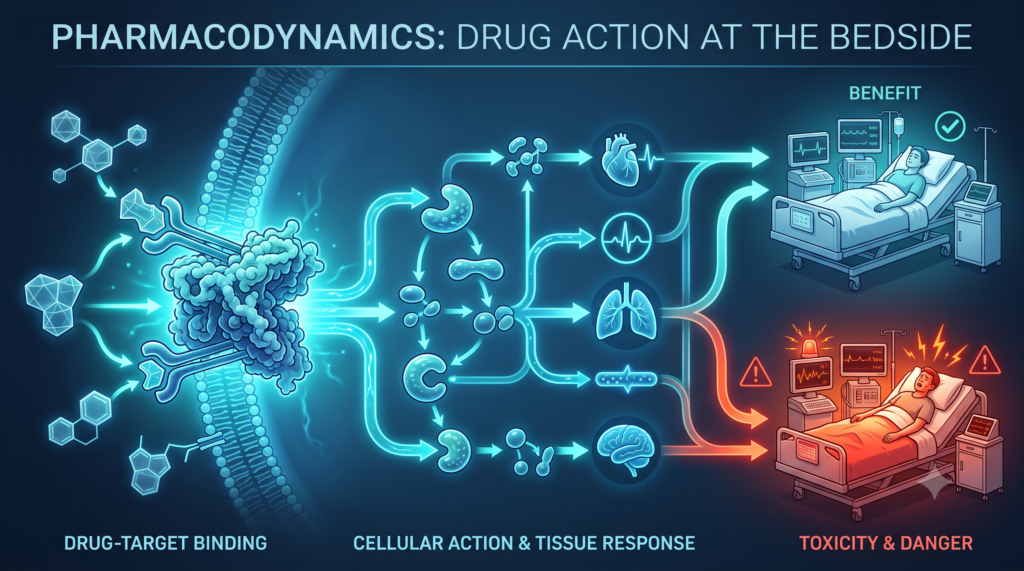
01. Pharmacodynamics: Drug Action at the Bedside
You don't currently have access to this content
02. The Pharmacodynamic Chain
You don't currently have access to this content
03. Pharmacodynamics vs Pharmacokinetics
You don't currently have access to this content
04. Drug Targets Are Not Only Receptors
You don't currently have access to this content
05. Selectivity, Specificity, and Polypharmacology
You don't currently have access to this content
06. Binding Kinetics and Target Occupancy
You don't currently have access to this content
07. Binding Affinity
You don't currently have access to this content
08. Residence Time and Duration of Action
You don't currently have access to this content
Quick Recall Check 1: Foundations and exposure
You don't currently have access to this content
09. Event-Driven Pharmacology
You don't currently have access to this content
10. Four Major Receptor Families
You don't currently have access to this content
11. Ligand-Gated Ion Channels
You don't currently have access to this content
12. GPCR Signaling and Amplification
You don't currently have access to this content
13. Gs, Gi, and Gq G-Protein Coupled Signaling Pathways
You don't currently have access to this content
14. Enzyme-Linked Receptors
You don't currently have access to this content
15. Intracellular Receptors
You don't currently have access to this content
16. Biased Agonism
You don't currently have access to this content
17. Biologics and Monoclonal Antibodies
You don't currently have access to this content
Quick Recall Check 2: Receptor families and signaling
You don't currently have access to this content
18. Graded Concentration–Response Curves
You don't currently have access to this content
19. Potency vs Efficacy
You don't currently have access to this content
20. EC50, Hill Slope, and Cooperativity
You don't currently have access to this content
21. Two-State Receptor Model
You don't currently have access to this content
22. Agonist Classes
You don't currently have access to this content
23. Partial Agonists in Practice
You don't currently have access to this content
24. Receptor Reserve and Operational Efficacy
You don't currently have access to this content
Quick Recall Check 3: Response curves and agonism
You don't currently have access to this content
25. Map of Antagonism
You don't currently have access to this content
26. Competitive Antagonism and Naloxone
You don't currently have access to this content
27. Schild Analysis and pA2
You don't currently have access to this content
28. Noncompetitive and Irreversible Antagonism
You don't currently have access to this content
29. Targeted Covalent Inhibition
You don't currently have access to this content
30. Allosteric Modulation
You don't currently have access to this content
31. Physiologic and Chemical Antagonism
You don't currently have access to this content
32. Drug Combinations: Additivity and Synergy
You don't currently have access to this content
Quick Recall Check 4: Antagonism and combinations
You don't currently have access to this content
33. Target Plasticity
You don't currently have access to this content
34. Homologous vs Heterologous Desensitization
You don't currently have access to this content
35. Tolerance, Tachyphylaxis, and Dependence
You don't currently have access to this content
36. Up-Regulation, Rebound, and Withdrawal
You don't currently have access to this content
37. Disease Changes Pharmacodynamics
You don't currently have access to this content
38. Quantal Dose–Response Curves
You don't currently have access to this content
39. Therapeutic Index and Safety Metrics
You don't currently have access to this content
40. Monitoring: Concentrations, Biomarkers, Endpoints
You don't currently have access to this content
41. Pharmacogenomics and Precision Pharmacodynamics
You don't currently have access to this content
Quick Recall Check 5: Adaptation, disease, and safety
You don't currently have access to this content
42. Clinical Prescribing Framework
You don't currently have access to this content
43. Integrated Case: Inadequate Response
You don't currently have access to this content
44. Final Synthesis
You don't currently have access to this content
Foundations of Mastery: Comprehensive Final Assessment
You don't currently have access to this content
Clinical Application & Mastery Assessment
You don't currently have access to this content