
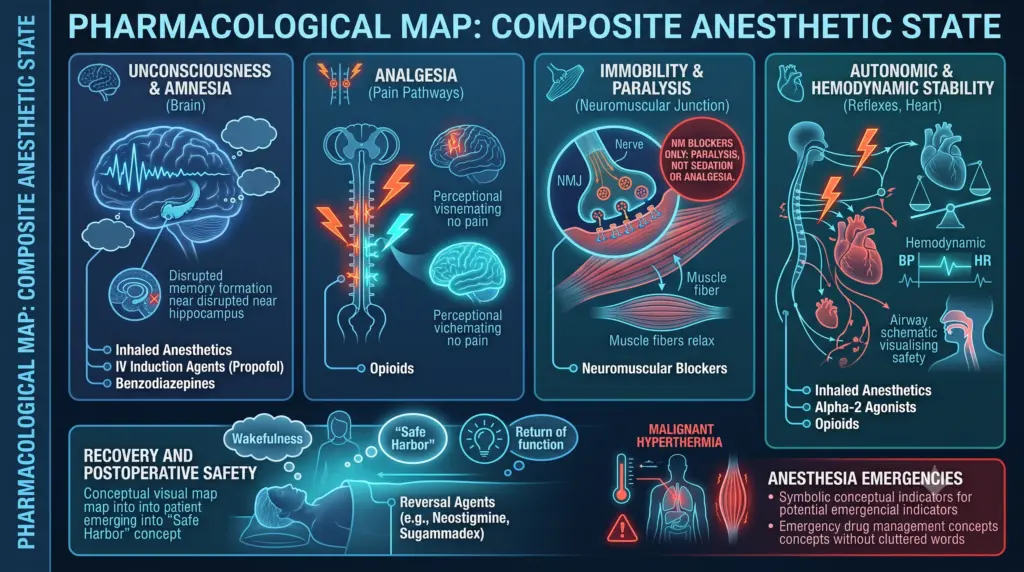
Connect anesthetic drug mechanisms and pharmacokinetics with balanced anesthesia, clinical selection, monitoring, adverse effects, and safe patient care.
Course Content
01. Anesthetic Pharmacology: Clinical Map
You don't currently have access to this content
02. Definitions: Sedation, Anesthesia, Analgesia, Paralysis
You don't currently have access to this content
03. Balanced Anesthesia: Why Multiple Drugs Are Used
You don't currently have access to this content
04. Sedation Continuum and Rescue Logic
You don't currently have access to this content
05. Monitoring During Sedation and General Anesthesia
You don't currently have access to this content
06. Molecular Targets of Anesthetic Drugs
You don't currently have access to this content
07. Phases of General Anesthesia and Context-Sensitive Half-Life
You don't currently have access to this content
08. Inhaled Anesthetics: MAC and Solubility
You don't currently have access to this content
09. Volatile Anesthetics: Sevoflurane, Desflurane, Isoflurane
You don't currently have access to this content
10. Nitrous Oxide: Analgesic Gas with Trapped-Air Risk
You don't currently have access to this content
11. Intravenous Induction Agents: Core Comparison
You don't currently have access to this content
12. Propofol: Rapid Hypnosis with Cardiorespiratory Risk
You don't currently have access to this content
13. Ketamine, Etomidate, and Dexmedetomidine
You don't currently have access to this content
14. Opioids, Benzodiazepines, and Reversal Agents
You don't currently have access to this content
15. Neuromuscular Blockers: The Safety Rule
You don't currently have access to this content
16. Succinylcholine: Rapid Depolarizing Blockade
You don't currently have access to this content
17. Nondepolarizing Blockers and Reversal
You don't currently have access to this content
18. Local Anesthetics: Mechanism, pKa, and Ion Trapping
You don't currently have access to this content
19. Local Anesthetic Classes, Prototypes, and Additives
You don't currently have access to this content
20. Neuraxial and Regional Anesthesia
You don't currently have access to this content
21. Local Anesthetic Systemic Toxicity
You don't currently have access to this content
22. Malignant Hyperthermia
You don't currently have access to this content
23. Other Anesthesia Emergencies
You don't currently have access to this content
24. Emergence, PACU, and Postoperative Safety
You don't currently have access to this content
25. Special Populations and Drug Selection
You don't currently have access to this content
26. Integrated Clinical Reasoning Scenarios
You don't currently have access to this content
27. High-Yield Board Mechanism Review
You don't currently have access to this content
28. Final Clinical Takeaways
You don't currently have access to this content