
How It Works
A structured method for pharmacology learning and clinical reasoning.
Combine focused lessons, retrieval practice and case-based questions with formative assessment, corrective feedback and targeted review. The aim is to strengthen pharmacology knowledge for board-exam preparation and therapeutic decision-making.
Deliberate practice cycle
A seven-step cycle for assessment and targeted review.
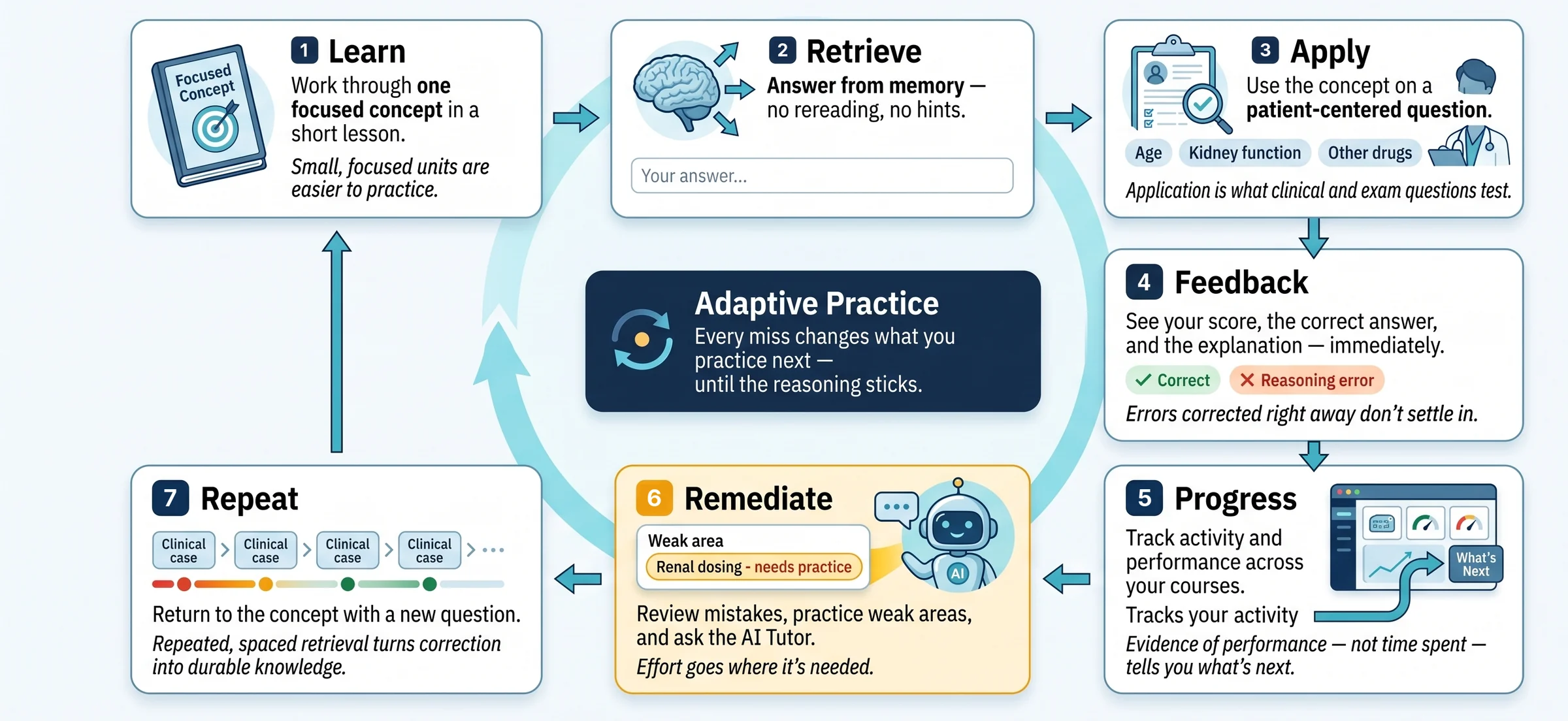
Knowledge retrieval and clinical application
Retrieve pharmacology principles and apply them to clinical cases.
Recall pharmacological mechanisms and principles.
Recall questions prompt you to retrieve key concepts before reviewing the lesson or answer rationale.
- Mechanisms of action
- Receptors and dose–response
- Pharmacokinetic principles
Evaluate patient-specific therapeutic decisions.
Clinical cases ask you to evaluate therapy choices, patient-specific dosing and monitoring. Review the rationale for the selected answer.
- Which patient factor changes the choice?
- What response or harm do you expect?
- What will you adjust and monitor?
Formative assessment and remediation
Turn assessment results into a focused study plan.
Review the correct answer and explanation, identify the concept that needs attention and use available review or follow-up practice.
- 1 · FEEDBACKQuick Recall Check2 / 4Illustrative result✓ Mechanism of action✕ Renal dose adjustment
Review the missed concept with the correct answer and explanatory feedback.
- 2 · WEAK AREASRecommendedRenal dosing · needs practice
Suggested review topic based on the assessment result.
Practice weak areasReview mistakesTargeted remediation focuses review on concepts identified in assessment results. Available follow-up questions vary by course.
- 3 · AI TUTORGrounded reviewWhy was my answer wrong? A renally cleared drug accumulates when creatinine clearance falls, so exposure rises… Source: the lesson you just studied
Examine the reasoning and return to the relevant lesson section.
Illustrations of the learner experience. Available practice and follow-up questions depend on each course.
The research behind the method
Learning principles supported by published research.
Research in education and medical training supports retrieval practice, feedback and repeated practice with defined goals. PharmaDrills uses these principles to guide its design; its effects on board scores, clinical performance and patient safety have not been established.
- Retrieval practice
Retrieving information from memory can improve long-term retention compared with rereading alone.
Roediger & Karpicke (2006), Psychological Science 17(3):249–255; Larsen, Butler & Roediger (2008), Medical Education 42(10):959–966. - Deliberate practice
Focused repetition of defined tasks with corrective feedback improves specific clinical skills in medical simulation studies. Transfer to clinical practice depends on the task and training design.
McGaghie et al. (2011), Academic Medicine 86(6):706–711. - Feedback
Feedback can support learning when it clarifies the performance goal, explains the error and identifies an actionable next step.
Hattie & Timperley (2007), Review of Educational Research 77(1):81–112. - Spaced practice
Distributing study sessions over time generally supports longer-term retention compared with a single concentrated session.
Cepeda et al. (2006), Psychological Bulletin 132(3):354–380.
Further reading
Explore the training method and curriculum.
Begin clinical reasoning practice in Module 1.
Five foundational courses, free during launch. No credit card required.